Tuesday, July 29, 2025

Yokosuka MXY-7 Ohka - Desperation Weapon of the Pacific War

The Yokosuka MXY-7 Ohka, meaning “cherry blossom” in Japanese, was a rocket-powered manned weapon developed by the Imperial Japanese Navy during the final stages of World War II. Introduced in 1945, the Ohka was designed specifically as a suicide attack aircraft intended to strike Allied naval vessels with overwhelming speed and explosive force.

The aircraft carried a 2,000-pound warhead mounted directly in the nose ahead of the pilot. Operationally, the Ohka was transported beneath a Mitsubishi G4M “Betty” bomber and released near the target area. Once detached, the pilot ignited the rear-mounted Type 4 Mark 1 Model 20 rocket motors, which could be fired individually or simultaneously. Although the Ohka had an extremely limited range of approximately 23 miles, it was capable of reaching speeds of roughly 400 miles per hour in level flight and up to 680 miles per hour in a terminal dive, making interception difficult once launched.

The Ohka saw combat primarily during the Okinawa campaign in 1945. Of the 74 aircraft committed to operations, 56 were destroyed either with their carrier aircraft or during attack attempts. Allied forces assigned the nickname “Baka” to the Ohka, a Japanese term meaning “foolish,” reflecting both its crude simplicity and the extreme human cost of its use. In total, approximately 852 Ohkas were produced. Today, only about 13 surviving examples are known to exist in museums worldwide.

The model presented here depicts an Ohka captured on Okinawa in April 1945. It is shown unarmed, without its warhead installed, and resting unsecured on its transport cradle and rear support. This configuration reflects how many Ohkas were discovered by Allied forces - as unfinished or unused weapons, emblematic of a program that arrived too late to alter the outcome of the war.

The intent of this build was to present the Ohka not as a curiosity, but as a physical representation of the desperation and industrial collapse facing Japan in 1945 - a weapon defined less by innovation than by circumstance.




Monday, July 21, 2025

WW2 Messerschmitt Me 262 HG III — Pushing the Limits of Germany’s First Jet Fighter

This build represents the Messerschmitt Me 262 HG III, one of the most radical high-speed development studies derived from the world’s first operational jet fighter. Conceived in the closing stages of the war, the HG program pushed aerodynamic refinement, propulsion integration, and overall performance far beyond the standard Schwalbe.

The model was finished using acrylics and Alclad II metallics, with oils and pigments applied selectively to suggest restrained operational wear rather than heavy service weathering. All national markings were airbrushed to maintain scale fidelity. Additional details include scratch-added seatbelts, brake and engine plumbing, a brass pitot tube, and subtly weighted tires, bringing a greater sense of realism to this experimental airframe.

The intent of this build was to capture the technical ambition of the HG III concept - a machine defined more by engineering possibility than operational history while keeping the finish believable, controlled, and grounded in late-war German jet development.


Monday, July 14, 2025

WW2 German Heinkel He219 A-7 Uhu - Germany’s Most Advanced Night Fighter

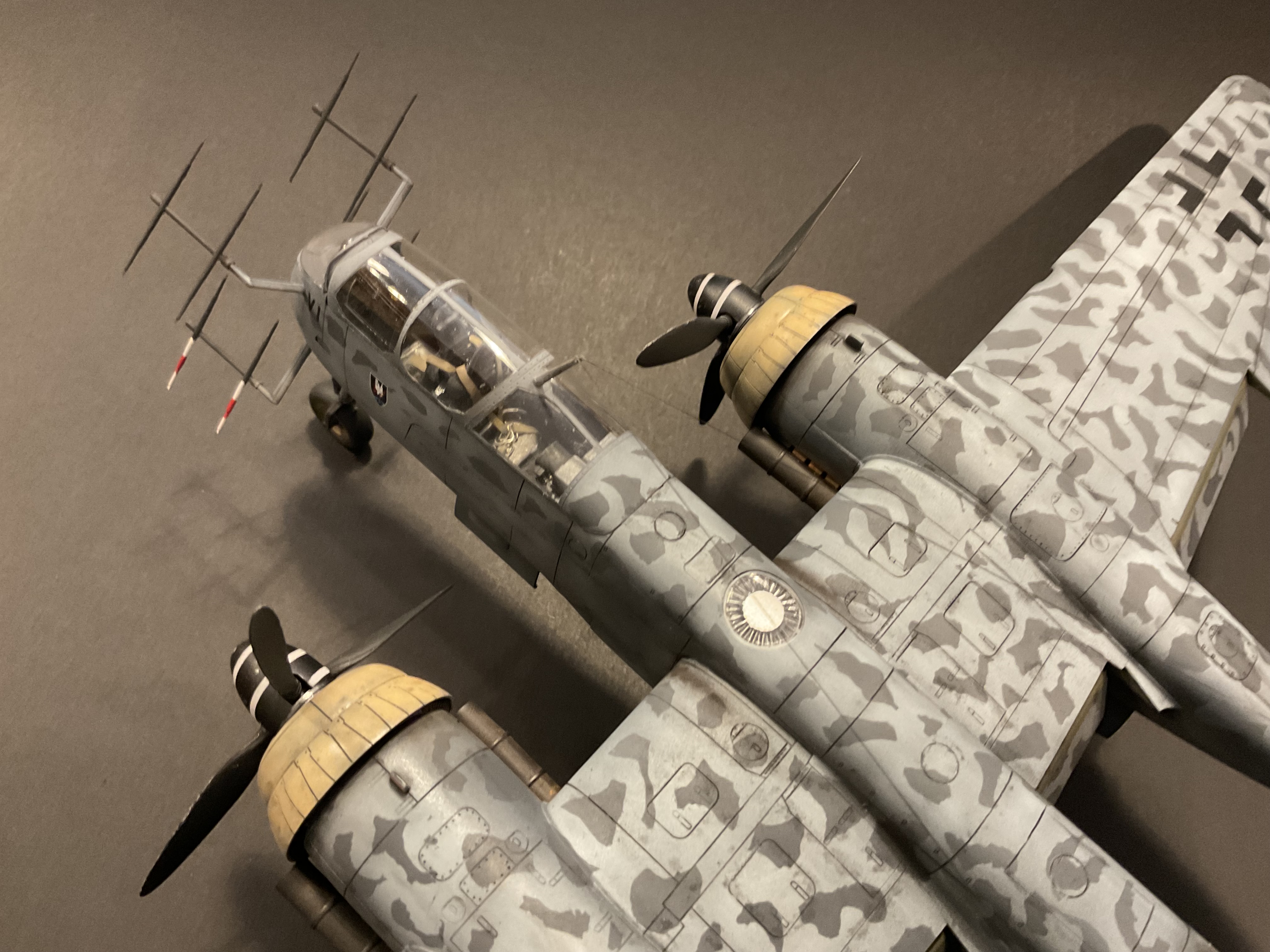
The Heinkel He 219 Uhu was one of the most advanced night fighters to see service during the Second World War, incorporating a number of innovations well ahead of its time. Designed specifically for the interception of Allied bombers under cover of darkness, the He 219 featured multiple radar array configurations, heavy forward firepower, and a purpose-built airframe optimized for night operations.

Among its most notable features were upward-firing cannons for oblique attacks, the first steerable nose wheel fitted to an operational German aircraft, and the world’s first operational use of ejection seats. Armament on the A-7 variant was formidable, consisting of two MG 151/20 cannons mounted in a detachable ventral tray, two additional MG 151/20 cannons in the wing roots, and two 30mm MK 108 cannons mounted in the upper fuselage at an angle for attacks from below.

Powered by two Daimler-Benz V-12 engines producing approximately 1,776 horsepower each, the He 219 had a top speed of around 420 mph at 23,000 feet. With a crew of two and a heavy weapons load, the Uhu represented the pinnacle of German piston-engine night fighter design, combining advanced technology with lethal effectiveness during the final years of the war.


Sunday, July 6, 2025

WW2 Era German Focke-Wulf Triebflügel - Germany’s Vertical Takeoff Fighter That Never Flew

One of the most unconventional aircraft concepts to emerge from German design studies during the Second World War was the Focke-Wulf Triebflügel, a radical attempt to solve the problem of air defense through vertical takeoff and high-speed interception. Conceived late in the war, the Triebflügel was designed to operate without conventional runways, launching vertically and transitioning to horizontal flight once sufficient altitude and speed were achieved.

The aircraft was to be powered by three Pabst ramjet engines mounted at the tips of rotating wings. During takeoff, the rotors would spin vertically to generate lift in a manner similar to a helicopter. Once airborne, the pilot would gradually tilt the aircraft into level flight, with the rotors continuing to spin and provide forward propulsion. For landing, the process would be reversed, requiring the pilot to slow the aircraft, pitch the fuselage upright, and descend vertically back onto its landing gear.

Although the Triebflügel never progressed beyond wind tunnel testing, projected performance figures were remarkable, with an estimated top speed of approximately 621 mph and a service ceiling near 50,000 feet. For this build, I chose to explore a plausible late-war operational appearance, applying a worn Luftwaffe light blue RLM 76 base combined with a splinter-style camouflage. The intent was to present the Triebflügel as a war-weary interceptor, a machine pushed into service during desperate final conditions where radical engineering met urgent necessity.


Monday, June 30, 2025

WW2 German Messerschmitt P.1103 - The Little Interceptor That Never Got Its Chance

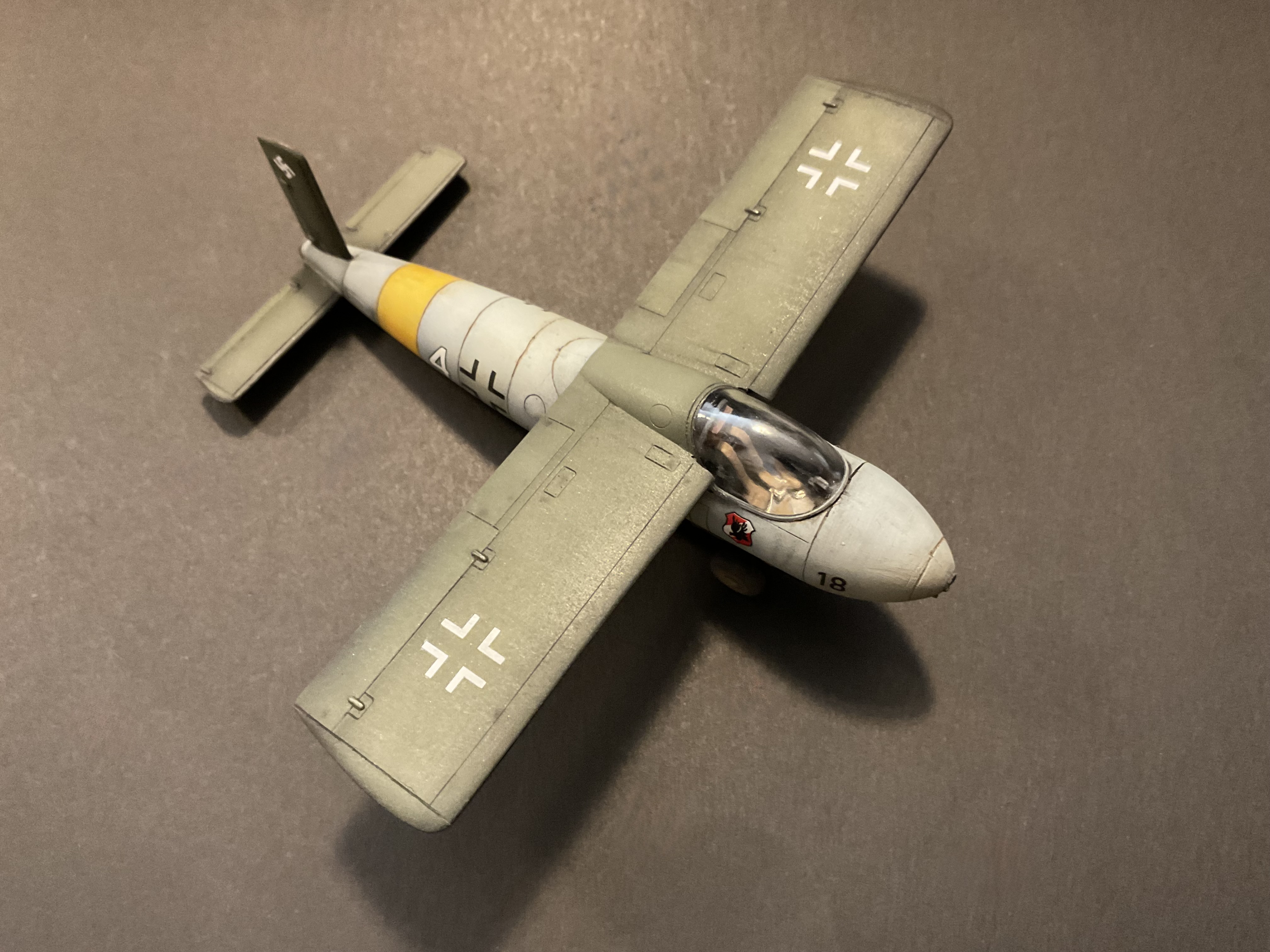
The Messerschmitt P.1103 was one of the more austere late-war interceptor concepts to emerge from Germany’s rapidly collapsing aircraft development programs. Designed as a compact, rocket-powered point-defense fighter, the P.1103 emphasized simplicity, rapid climb, and ease of production over pilot comfort or operational longevity.

Intended to be powered by a Walter rocket motor, the P.1103 was conceived as a short-duration interceptor capable of quickly reaching bomber formations, delivering a brief but violent attack, and then gliding back to base. Its small size, minimal airframe, and extremely limited endurance reflected the harsh realities facing German designers late in the war, where material shortages and mounting Allied air superiority dictated increasingly desperate solutions.

For this build, the goal was to present the P.1103 not as a polished prototype, but as a plausible frontline machine pressed into service under extreme conditions. Subtle weathering and restrained detailing were used to emphasize scale and realism, particularly around the landing gear and ground-contact areas, where wear would accumulate most quickly on such a small and lightly built aircraft. Though often overshadowed by larger and more famous projects, the P.1103 remains a fascinating example of late-war engineering stripped to its bare essentials — and a reminder that not every radical idea was meant to be elegant.


Saturday, May 24, 2025

WW2 Japanese Kyushu J7W1 Shinden - Japan’s Radical Last-Ditch Interceptor

The Kyushu J7W1 Shinden was one of the most unconventional fighter designs to emerge from Japan during the final stages of the Second World War. Conceived as a high-performance interceptor to counter high-altitude Allied bombers, the Shinden employed a canard configuration that placed the main wings aft and control surfaces forward, an arrangement chosen to improve firepower concentration, pilot visibility, and high-speed performance.

Only two prototypes were completed before Japan’s surrender. Power was provided by a 2,130 horsepower Mitsubishi Ha-43 radial engine mounted behind the cockpit, driving a six-bladed propeller through an extension shaft. Engine cooling was handled by long, narrow intakes mounted obliquely along the fuselage sides. Of the two prototypes built, one flew for a total of approximately 45 minutes before the war ended. One airframe was later scrapped, while the other was shipped to the United States for evaluation and never flown again.


Tuesday, April 29, 2025

USMC LVTH-6A1 Vietnam Theater - Marine Corps Fire Support from Sea to Shore

The LVTH-6A1 was an amphibious assault vehicle developed to provide direct artillery support for United States Marine Corps operations during the Vietnam War. Designed to land with the first assault waves, the LVTH-6A1 combined the mobility of an amphibious tracked vehicle with the firepower of a 105mm howitzer, allowing Marine units to bring immediate indirect and direct fire support ashore without waiting for conventional artillery deployment.

Based on the LVTP series chassis, the LVTH-6A1 was intended to operate in coastal environments, riverine terrain, and soft ground where traditional artillery systems struggled to keep pace with advancing infantry. Its enclosed turret mounted the 105mm howitzer, supported by secondary machine guns, providing suppressive fire, bunker reduction capability, and rapid response fire missions in support of ground forces.

Only 210 vehicles were produced, and while the LVTH-6A1 was never a glamorous machine, it filled a critical niche during amphibious and near-shore operations. For this build, the vehicle is depicted in Vietnam-era service, finished with restrained weathering using acrylics, oils, and pigments to reflect hard use in a humid, abrasive environment. The goal was to portray a working vehicle - functional, worn, and purposeful - rather than a pristine display piece.


Monday, April 21, 2025

155mm Self-Propelled Howitzer G6 Rhino - Long-Range Artillery Built for the African Battlefield

The G6 Rhino is a 155mm self-propelled howitzer developed for the South African National Defence Force, designed to deliver long-range artillery fire while operating independently across vast, hostile terrain. Unlike tracked artillery systems intended for European battlefields, the G6 was purpose-built for long-distance mobility, survivability, and sustained operations in open environments where infrastructure and support were limited.

Mounted on a large six-wheeled armored chassis, the G6 combines strategic mobility with heavy firepower. Stabilizing hydraulic spades at the front and rear anchor the vehicle during firing, allowing it to deliver accurate artillery fire while remaining capable of rapid displacement. The 155mm gun is capable of firing high-explosive rounds at ranges exceeding 40 miles, with a sustained rate of fire of approximately two to four rounds per minute, emphasizing reach and precision over sheer volume.

For this build, the emphasis was placed on portraying the G6 as a hard-used, operational vehicle rather than a factory-fresh example. Finished in acrylics with restrained use of weathering, the model reflects the dust, heat, and wear associated with extended operations in arid environments. The intent was to capture the G6 Rhino as it was designed to be used - distant, deliberate, and devastatingly effective.


Monday, March 24, 2025

Grand Banks Dory - A Working Boat Built for the North Atlantic

The Grand Banks dory is one of the most recognizable and enduring small working boats in North American maritime history. Developed for the demanding conditions of the North Atlantic, these boats were designed with a simple but highly effective hull form that emphasized stability, load-carrying capacity, and ease of handling in rough seas.

Used extensively from the early 1700s onward, Bank dories served both inshore and offshore fishing operations, particularly in conjunction with larger fishing vessels operating on the Grand Banks. Their straight sides, flat bottoms, and pronounced sheer allowed them to be stacked aboard mother ships, launched quickly, and worked hard under difficult conditions.

This model represents a 12-foot Grand Banks dory, the smallest of the five standard dory classes. Built from a wooden kit in 1/12 scale and finished in acrylics, the focus of the build was on clean lines, subtle surface variation, and an honest working appearance rather than heavy weathering. The intent was to capture the quiet utility of a boat designed not for display, but for daily labor at sea - simple, capable, and enduring.