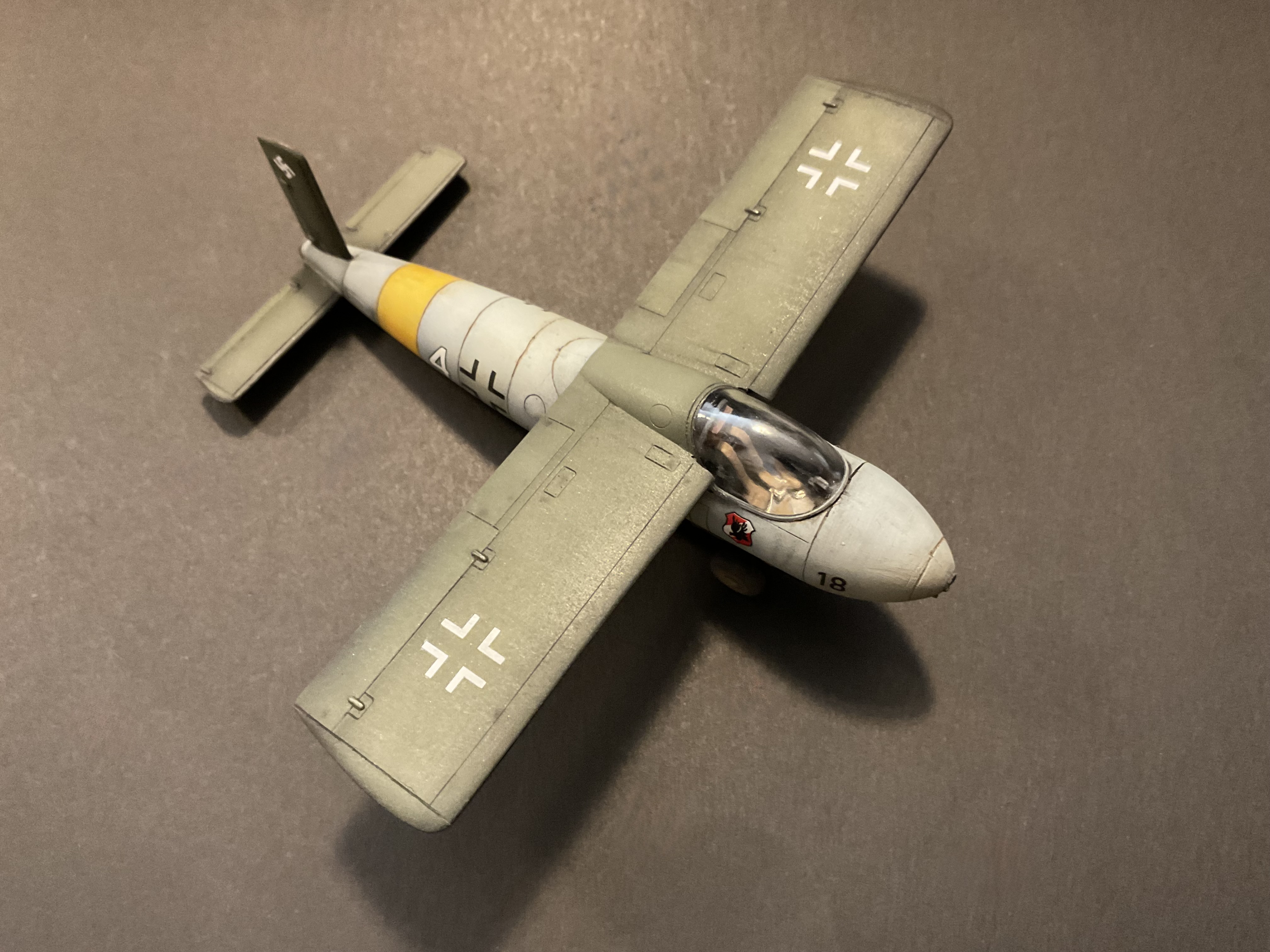
The Messerschmitt P.1103 was one of the more austere late-war interceptor concepts to emerge from Germany’s rapidly collapsing aircraft development programs. Designed as a compact, rocket-powered point-defense fighter, the P.1103 emphasized simplicity, rapid climb, and ease of production over pilot comfort or operational longevity.
Intended to be powered by a Walter rocket motor, the P.1103 was conceived as a short-duration interceptor capable of quickly reaching bomber formations, delivering a brief but violent attack, and then gliding back to base. Its small size, minimal airframe, and extremely limited endurance reflected the harsh realities facing German designers late in the war, where material shortages and mounting Allied air superiority dictated increasingly desperate solutions.
For this build, the goal was to present the P.1103 not as a polished prototype, but as a plausible frontline machine pressed into service under extreme conditions. Subtle weathering and restrained detailing were used to emphasize scale and realism, particularly around the landing gear and ground-contact areas, where wear would accumulate most quickly on such a small and lightly built aircraft. Though often overshadowed by larger and more famous projects, the P.1103 remains a fascinating example of late-war engineering stripped to its bare essentials — and a reminder that not every radical idea was meant to be elegant.


No comments:
Post a Comment