Monday, June 30, 2025

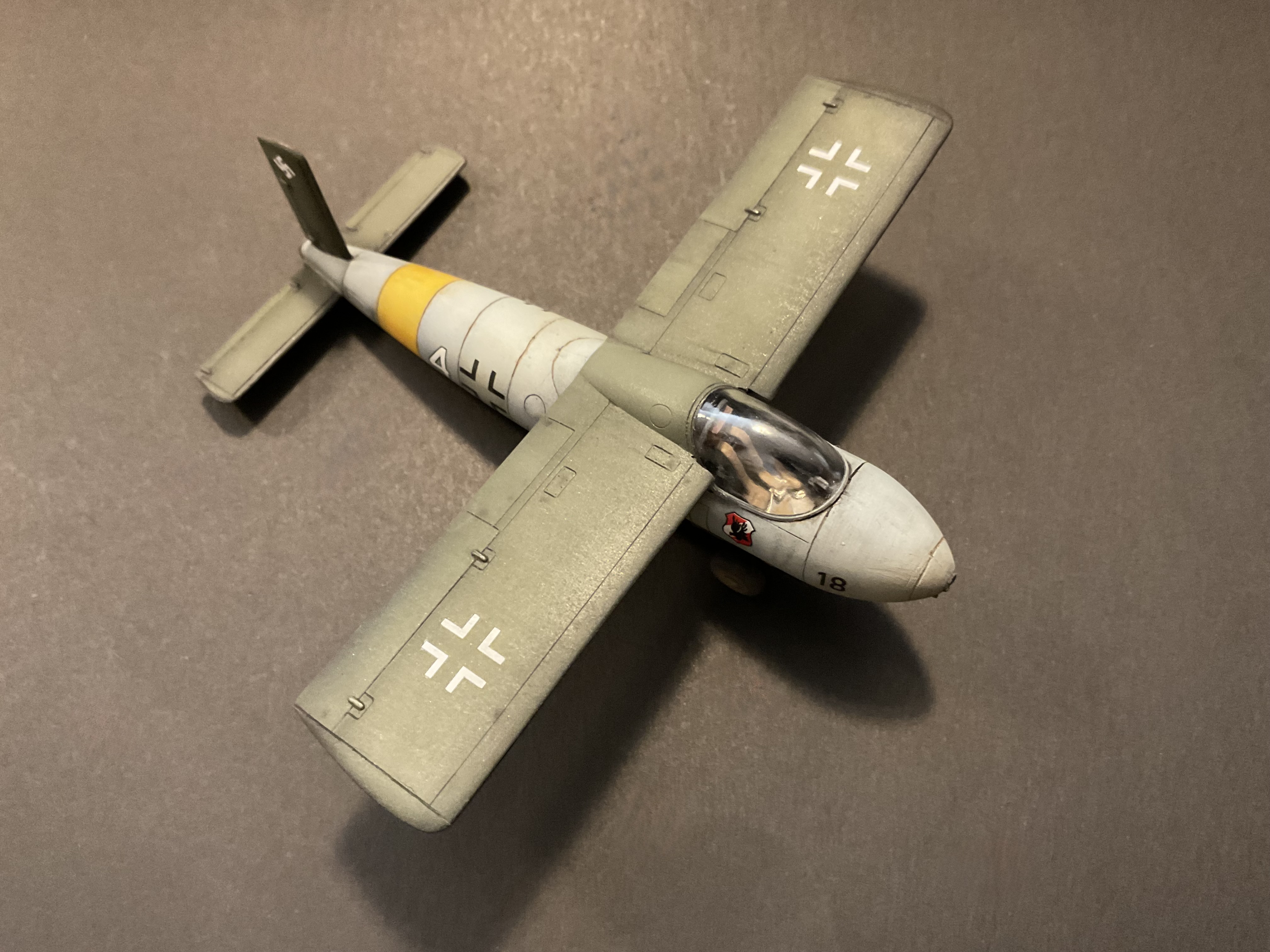
WW2 German Messerschmitt P.1103 - The Little Interceptor That Never Got Its Chance

The Messerschmitt P.1103 was one of the more austere late-war interceptor concepts to emerge from Germany’s rapidly collapsing aircraft development programs. Designed as a compact, rocket-powered point-defense fighter, the P.1103 emphasized simplicity, rapid climb, and ease of production over pilot comfort or operational longevity.

Intended to be powered by a Walter rocket motor, the P.1103 was conceived as a short-duration interceptor capable of quickly reaching bomber formations, delivering a brief but violent attack, and then gliding back to base. Its small size, minimal airframe, and extremely limited endurance reflected the harsh realities facing German designers late in the war, where material shortages and mounting Allied air superiority dictated increasingly desperate solutions.

For this build, the goal was to present the P.1103 not as a polished prototype, but as a plausible frontline machine pressed into service under extreme conditions. Subtle weathering and restrained detailing were used to emphasize scale and realism, particularly around the landing gear and ground-contact areas, where wear would accumulate most quickly on such a small and lightly built aircraft. Though often overshadowed by larger and more famous projects, the P.1103 remains a fascinating example of late-war engineering stripped to its bare essentials — and a reminder that not every radical idea was meant to be elegant.




Saturday, May 24, 2025

WW2 Japanese Kyushu J7W1 Shinden - Japan’s Radical Last-Ditch Interceptor

The Kyushu J7W1 Shinden was one of the most unconventional fighter designs to emerge from Japan during the final stages of the Second World War. Conceived as a high-performance interceptor to counter high-altitude Allied bombers, the Shinden employed a canard configuration that placed the main wings aft and control surfaces forward, an arrangement chosen to improve firepower concentration, pilot visibility, and high-speed performance.

Only two prototypes were completed before Japan’s surrender. Power was provided by a 2,130 horsepower Mitsubishi Ha-43 radial engine mounted behind the cockpit, driving a six-bladed propeller through an extension shaft. Engine cooling was handled by long, narrow intakes mounted obliquely along the fuselage sides. Of the two prototypes built, one flew for a total of approximately 45 minutes before the war ended. One airframe was later scrapped, while the other was shipped to the United States for evaluation and never flown again.


Tuesday, April 29, 2025

USMC LVTH-6A1 Vietnam Theater - Marine Corps Fire Support from Sea to Shore

The LVTH-6A1 was an amphibious assault vehicle developed to provide direct artillery support for United States Marine Corps operations during the Vietnam War. Designed to land with the first assault waves, the LVTH-6A1 combined the mobility of an amphibious tracked vehicle with the firepower of a 105mm howitzer, allowing Marine units to bring immediate indirect and direct fire support ashore without waiting for conventional artillery deployment.

Based on the LVTP series chassis, the LVTH-6A1 was intended to operate in coastal environments, riverine terrain, and soft ground where traditional artillery systems struggled to keep pace with advancing infantry. Its enclosed turret mounted the 105mm howitzer, supported by secondary machine guns, providing suppressive fire, bunker reduction capability, and rapid response fire missions in support of ground forces.

Only 210 vehicles were produced, and while the LVTH-6A1 was never a glamorous machine, it filled a critical niche during amphibious and near-shore operations. For this build, the vehicle is depicted in Vietnam-era service, finished with restrained weathering using acrylics, oils, and pigments to reflect hard use in a humid, abrasive environment. The goal was to portray a working vehicle - functional, worn, and purposeful - rather than a pristine display piece.


Monday, April 21, 2025

155mm Self-Propelled Howitzer G6 Rhino - Long-Range Artillery Built for the African Battlefield

The G6 Rhino is a 155mm self-propelled howitzer developed for the South African National Defence Force, designed to deliver long-range artillery fire while operating independently across vast, hostile terrain. Unlike tracked artillery systems intended for European battlefields, the G6 was purpose-built for long-distance mobility, survivability, and sustained operations in open environments where infrastructure and support were limited.

Mounted on a large six-wheeled armored chassis, the G6 combines strategic mobility with heavy firepower. Stabilizing hydraulic spades at the front and rear anchor the vehicle during firing, allowing it to deliver accurate artillery fire while remaining capable of rapid displacement. The 155mm gun is capable of firing high-explosive rounds at ranges exceeding 40 miles, with a sustained rate of fire of approximately two to four rounds per minute, emphasizing reach and precision over sheer volume.

For this build, the emphasis was placed on portraying the G6 as a hard-used, operational vehicle rather than a factory-fresh example. Finished in acrylics with restrained use of weathering, the model reflects the dust, heat, and wear associated with extended operations in arid environments. The intent was to capture the G6 Rhino as it was designed to be used - distant, deliberate, and devastatingly effective.


Monday, March 24, 2025

Grand Banks Dory - A Working Boat Built for the North Atlantic

The Grand Banks dory is one of the most recognizable and enduring small working boats in North American maritime history. Developed for the demanding conditions of the North Atlantic, these boats were designed with a simple but highly effective hull form that emphasized stability, load-carrying capacity, and ease of handling in rough seas.

Used extensively from the early 1700s onward, Bank dories served both inshore and offshore fishing operations, particularly in conjunction with larger fishing vessels operating on the Grand Banks. Their straight sides, flat bottoms, and pronounced sheer allowed them to be stacked aboard mother ships, launched quickly, and worked hard under difficult conditions.

This model represents a 12-foot Grand Banks dory, the smallest of the five standard dory classes. Built from a wooden kit in 1/12 scale and finished in acrylics, the focus of the build was on clean lines, subtle surface variation, and an honest working appearance rather than heavy weathering. The intent was to capture the quiet utility of a boat designed not for display, but for daily labor at sea - simple, capable, and enduring.


Monday, March 17, 2025

Utility Skiff - A Small Boat Built for Everyday Work

This model represents an 8-foot, 6-inch two-man utility skiff, a small working boat whose basic design dates back to the nineteenth century and remains in use today. Rooted in traditional dory construction, this type of skiff was valued for its simplicity, stability, and versatility, making it well suited for everyday tasks such as tending moorings, transporting gear, or working close to shore.

The kit was built entirely from wood and follows the same construction methods used on the full-sized boat, with individual planks, frames, and interior details assembled in scale rather than simplified for modeling convenience. This approach preserves the character of the original design and highlights the straightforward, functional nature of the craft.

Built in 1/12 scale and finished in acrylics, the focus of this build was on clean workmanship and subtle surface variation rather than heavy weathering. The goal was to present the skiff as a lightly used, well-maintained working boat - practical, unpretentious, and ready for daily use.


Friday, February 28, 2025

U.S. Marine Corps AAVP7A1 Amphibious Assault Vehicle - When the Ocean Is the First Obstacle

The AAV7A1 Amphibious Assault Vehicle is a cornerstone of United States Marine Corps doctrine, designed to carry Marines directly from ship to shore and onward into combat. Built for operations where land begins at the waterline, the AAV7A1 combines ocean-going capability with tracked mobility, allowing it to operate in surf conditions that would defeat most armored vehicles.

Capable of navigating ocean waves up to nine feet high, the AAV7A1 can transport up to twenty-five fully equipped Marines while remaining seaworthy even under total immersion. Despite its amphibious role, it is a massive vehicle, comparable in length to the M1A1 Abrams main battle tank, and offers substantial protection and mobility once ashore.

This model is based on the 1992 Tamiya kit and was finished using acrylics along with a variety of weathering techniques to reflect hard service in demanding environments. The intent of the build was to portray the AAV7A1 as it is most often seen - worn, stained, and functional - a blunt but essential tool that exists to deliver Marines where they are needed, regardless of terrain or conditions.


Monday, February 10, 2025

M109A6 Paladin Self Propelled Howitzer - The Army’s Armored Artillery Workhorse

The M109A6 Paladin is a modernized self-propelled howitzer developed to provide responsive, armored artillery support for United States Army ground forces. Entering service as an evolution of the long-running M109 series, the Paladin combined improved fire control, mobility, and crew protection to meet the demands of late Cold War and post–Cold War combat operations.

Armed with a 155mm gun, the M109A6 was designed to deliver accurate, sustained fire while remaining highly mobile and capable of rapid displacement after firing. During Operation Iraqi Freedom in 2003, the Paladin played a critical role in supporting maneuver units across wide, fast-moving battlefields, where speed, coordination, and reliability were essential.

This model is based on an older Italeri kit later reissued by Tamiya, and required more preparation work than originally anticipated. Finished to represent a vehicle in U.S. Army service during Operation Iraqi Freedom, the build emphasizes a used, operational appearance rather than a pristine display finish. On a personal note, this was the vehicle type I would have crewed after serving with the USAF and joining the Army ranks had medical circumstances allowed, making this build both a technical project and a quiet reflection on what could have been. 


Friday, February 7, 2025

S-300V - Mobile Air Defense Built to Deny the Sky

The S-300V is a long-range, mobile surface-to-air missile system developed to provide layered air defense against aircraft, cruise missiles, and ballistic missile threats. Designed to operate as part of an integrated battlefield air defense network, the system combines powerful radar assets with heavy missile launchers mounted on tracked chassis, allowing it to deploy, fire, and relocate rapidly in response to evolving threats.

Unlike simpler point-defense systems, the S-300V was intended to protect large formations and critical assets over wide areas. Its vertically launched missiles and tall radar masts give the system a distinctive and imposing profile, emphasizing reach, detection capability, and engagement at significant distances rather than close-range interception.

This model depicts the S-300V in a deployed configuration and was built largely out of the box, with select enhancements including modified brass antennas and fully airbrushed markings. Finished using acrylics and oils, the emphasis was placed on clean construction, scale accuracy, and subtle weathering rather than heavy wear. With over 1,200 parts in the kit, the build reflects both the complexity of the real system and the engineering challenge of translating such a dense, technical platform into scale form.