Monday, March 24, 2025

Grand Banks Dory - A Working Boat Built for the North Atlantic

The Grand Banks dory is one of the most recognizable and enduring small working boats in North American maritime history. Developed for the demanding conditions of the North Atlantic, these boats were designed with a simple but highly effective hull form that emphasized stability, load-carrying capacity, and ease of handling in rough seas.

Used extensively from the early 1700s onward, Bank dories served both inshore and offshore fishing operations, particularly in conjunction with larger fishing vessels operating on the Grand Banks. Their straight sides, flat bottoms, and pronounced sheer allowed them to be stacked aboard mother ships, launched quickly, and worked hard under difficult conditions.

This model represents a 12-foot Grand Banks dory, the smallest of the five standard dory classes. Built from a wooden kit in 1/12 scale and finished in acrylics, the focus of the build was on clean lines, subtle surface variation, and an honest working appearance rather than heavy weathering. The intent was to capture the quiet utility of a boat designed not for display, but for daily labor at sea - simple, capable, and enduring.


Monday, March 17, 2025

Utility Skiff - A Small Boat Built for Everyday Work

This model represents an 8-foot, 6-inch two-man utility skiff, a small working boat whose basic design dates back to the nineteenth century and remains in use today. Rooted in traditional dory construction, this type of skiff was valued for its simplicity, stability, and versatility, making it well suited for everyday tasks such as tending moorings, transporting gear, or working close to shore.

The kit was built entirely from wood and follows the same construction methods used on the full-sized boat, with individual planks, frames, and interior details assembled in scale rather than simplified for modeling convenience. This approach preserves the character of the original design and highlights the straightforward, functional nature of the craft.

Built in 1/12 scale and finished in acrylics, the focus of this build was on clean workmanship and subtle surface variation rather than heavy weathering. The goal was to present the skiff as a lightly used, well-maintained working boat - practical, unpretentious, and ready for daily use.


Friday, February 28, 2025

U.S. Marine Corps AAVP7A1 Amphibious Assault Vehicle - When the Ocean Is the First Obstacle

The AAV7A1 Amphibious Assault Vehicle is a cornerstone of United States Marine Corps doctrine, designed to carry Marines directly from ship to shore and onward into combat. Built for operations where land begins at the waterline, the AAV7A1 combines ocean-going capability with tracked mobility, allowing it to operate in surf conditions that would defeat most armored vehicles.

Capable of navigating ocean waves up to nine feet high, the AAV7A1 can transport up to twenty-five fully equipped Marines while remaining seaworthy even under total immersion. Despite its amphibious role, it is a massive vehicle, comparable in length to the M1A1 Abrams main battle tank, and offers substantial protection and mobility once ashore.

This model is based on the 1992 Tamiya kit and was finished using acrylics along with a variety of weathering techniques to reflect hard service in demanding environments. The intent of the build was to portray the AAV7A1 as it is most often seen - worn, stained, and functional - a blunt but essential tool that exists to deliver Marines where they are needed, regardless of terrain or conditions.


Monday, February 10, 2025

M109A6 Paladin Self Propelled Howitzer - The Army’s Armored Artillery Workhorse

The M109A6 Paladin is a modernized self-propelled howitzer developed to provide responsive, armored artillery support for United States Army ground forces. Entering service as an evolution of the long-running M109 series, the Paladin combined improved fire control, mobility, and crew protection to meet the demands of late Cold War and post–Cold War combat operations.

Armed with a 155mm gun, the M109A6 was designed to deliver accurate, sustained fire while remaining highly mobile and capable of rapid displacement after firing. During Operation Iraqi Freedom in 2003, the Paladin played a critical role in supporting maneuver units across wide, fast-moving battlefields, where speed, coordination, and reliability were essential.

This model is based on an older Italeri kit later reissued by Tamiya, and required more preparation work than originally anticipated. Finished to represent a vehicle in U.S. Army service during Operation Iraqi Freedom, the build emphasizes a used, operational appearance rather than a pristine display finish. On a personal note, this was the vehicle type I would have crewed after serving with the USAF and joining the Army ranks had medical circumstances allowed, making this build both a technical project and a quiet reflection on what could have been. 


Friday, February 7, 2025

S-300V - Mobile Air Defense Built to Deny the Sky

The S-300V is a long-range, mobile surface-to-air missile system developed to provide layered air defense against aircraft, cruise missiles, and ballistic missile threats. Designed to operate as part of an integrated battlefield air defense network, the system combines powerful radar assets with heavy missile launchers mounted on tracked chassis, allowing it to deploy, fire, and relocate rapidly in response to evolving threats.

Unlike simpler point-defense systems, the S-300V was intended to protect large formations and critical assets over wide areas. Its vertically launched missiles and tall radar masts give the system a distinctive and imposing profile, emphasizing reach, detection capability, and engagement at significant distances rather than close-range interception.

This model depicts the S-300V in a deployed configuration and was built largely out of the box, with select enhancements including modified brass antennas and fully airbrushed markings. Finished using acrylics and oils, the emphasis was placed on clean construction, scale accuracy, and subtle weathering rather than heavy wear. With over 1,200 parts in the kit, the build reflects both the complexity of the real system and the engineering challenge of translating such a dense, technical platform into scale form.


Wednesday, January 22, 2025

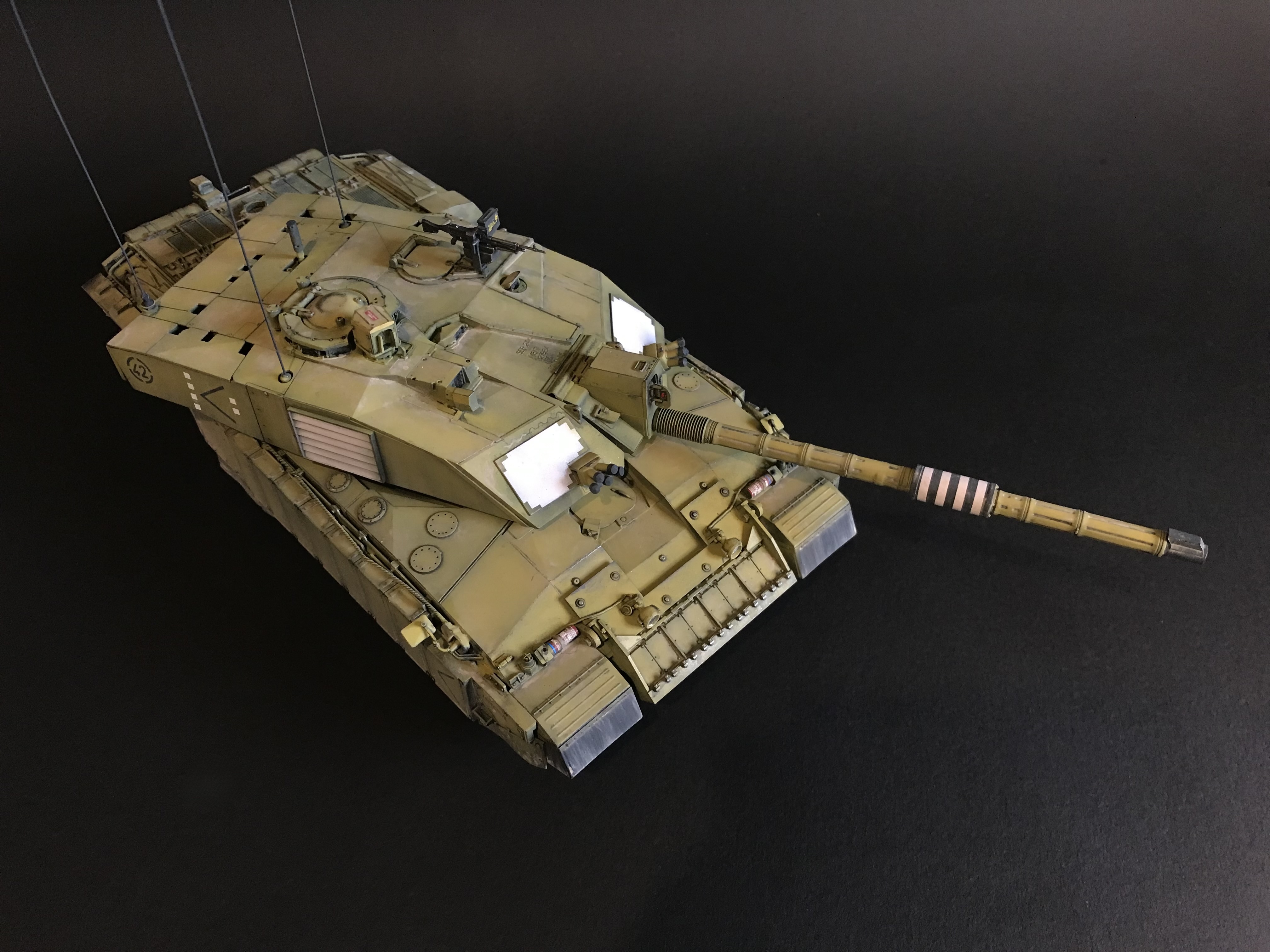
Challenger 2 - British Armor in the Modern Desert Battlefield

This model depicts a British Challenger 2 main battle tank configured for desert operations. Built from the Tamiya 1/35 scale kit and finished using acrylics, oils, and pigments, the vehicle is shown as operated by the Royal Scots Dragoon Guards, 7th Armoured Brigade, during operations in Afghanistan in April 2003.

A prominent feature of this configuration is the use of white thermal signature reduction panels mounted on the turret and hull. These panels were designed to help friendly forces distinguish the vehicle when viewed through night vision or thermal imaging equipment. By presenting cooler, darker shapes against the hotter background of the tank’s armor, the panels reduced the risk of misidentification and friendly fire incidents - lessons learned during earlier conflicts such as Desert Storm.

The intent of this build was to present the Challenger 2 as a working combat vehicle rather than a display piece. Weathering was applied with restraint to reflect operational use in a harsh environment, emphasizing dust accumulation, surface wear, and the subdued appearance of a tank designed first and foremost for crew protection and battlefield survivability.


Friday, January 10, 2025

V-1 Flying Bomb - The World’s First Cruise Missile

The V-1 flying bomb is widely regarded as the world’s first operational cruise missile, marking a significant - and troubling - milestone in the history of guided weapons. Deployed by Germany during the later stages of the Second World War, the V-1 was used primarily as a terror weapon against civilian targets, most notably London. Despite its technological significance, the system was notoriously inaccurate and unreliable.

This model is presented in 1/48 scale and was assembled using components from two different kits. The launch cradle and catapult equipment were taken from the Tamiya kit, while the V-1 airframe itself is an older MPM release. The decision to combine kits was driven by accuracy concerns, as the Tamiya V-1 suffers from several dimensional issues, including an engine cowling that is too long, resulting in an incorrect stanchion length between the fuselage and pulsejet.

Additional detailing was added to improve realism and fidelity to period photographs. These enhancements include work in the fuel section, rudder control mechanisms, cradle details, and a number of smaller corrections and additions. The goal of the build was not to present a flawless or refined weapon, but rather to capture the crude, utilitarian nature of the V-1 - a weapon significant for what it represented historically, not for its effectiveness or precision.