Wednesday, January 22, 2025

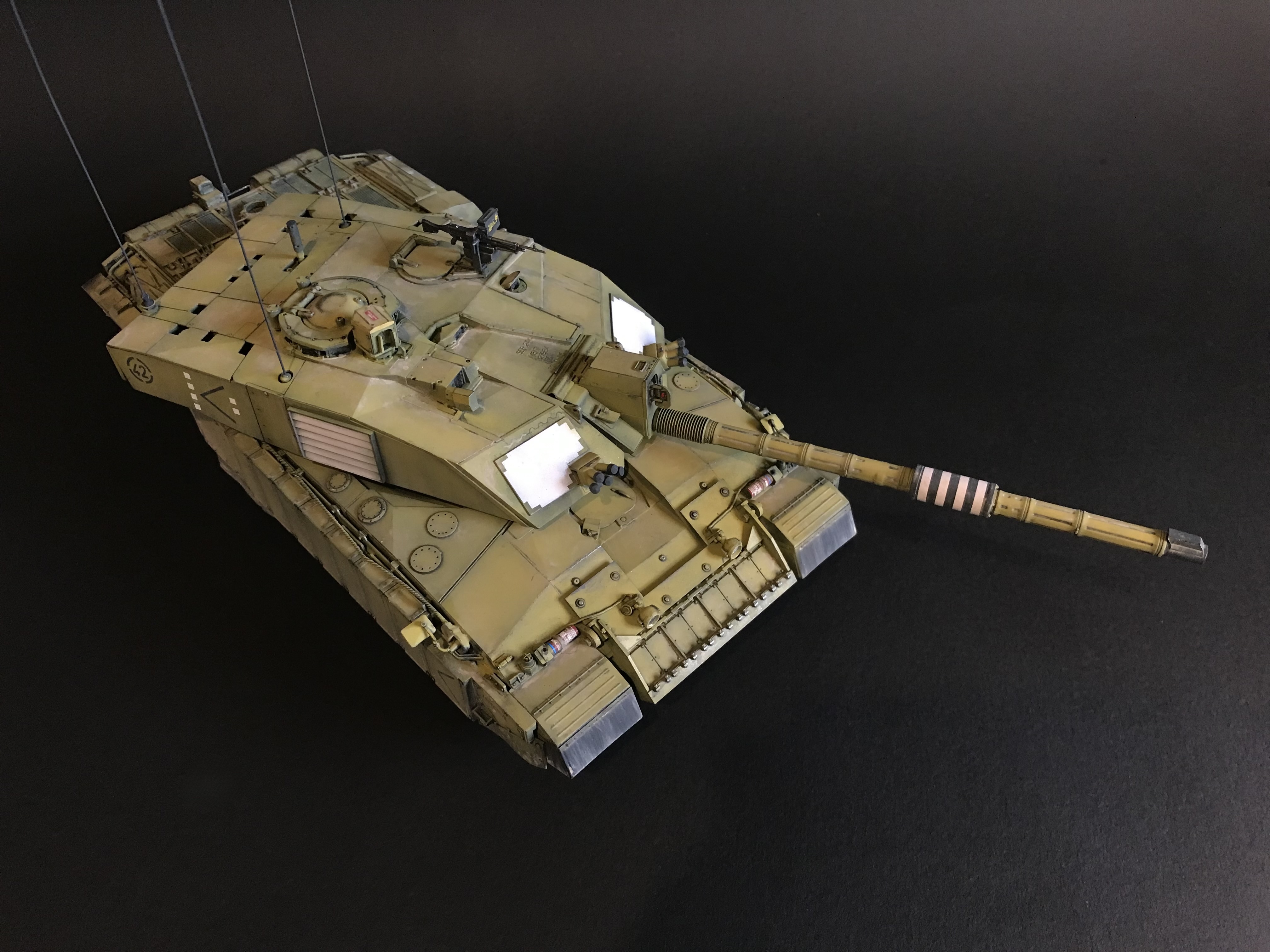
Challenger 2 - British Armor in the Modern Desert Battlefield

This model depicts a British Challenger 2 main battle tank configured for desert operations. Built from the Tamiya 1/35 scale kit and finished using acrylics, oils, and pigments, the vehicle is shown as operated by the Royal Scots Dragoon Guards, 7th Armoured Brigade, during operations in Afghanistan in April 2003.

A prominent feature of this configuration is the use of white thermal signature reduction panels mounted on the turret and hull. These panels were designed to help friendly forces distinguish the vehicle when viewed through night vision or thermal imaging equipment. By presenting cooler, darker shapes against the hotter background of the tank’s armor, the panels reduced the risk of misidentification and friendly fire incidents - lessons learned during earlier conflicts such as Desert Storm.

The intent of this build was to present the Challenger 2 as a working combat vehicle rather than a display piece. Weathering was applied with restraint to reflect operational use in a harsh environment, emphasizing dust accumulation, surface wear, and the subdued appearance of a tank designed first and foremost for crew protection and battlefield survivability.




Friday, January 10, 2025

V-1 Flying Bomb - The World’s First Cruise Missile

The V-1 flying bomb is widely regarded as the world’s first operational cruise missile, marking a significant - and troubling - milestone in the history of guided weapons. Deployed by Germany during the later stages of the Second World War, the V-1 was used primarily as a terror weapon against civilian targets, most notably London. Despite its technological significance, the system was notoriously inaccurate and unreliable.

This model is presented in 1/48 scale and was assembled using components from two different kits. The launch cradle and catapult equipment were taken from the Tamiya kit, while the V-1 airframe itself is an older MPM release. The decision to combine kits was driven by accuracy concerns, as the Tamiya V-1 suffers from several dimensional issues, including an engine cowling that is too long, resulting in an incorrect stanchion length between the fuselage and pulsejet.

Additional detailing was added to improve realism and fidelity to period photographs. These enhancements include work in the fuel section, rudder control mechanisms, cradle details, and a number of smaller corrections and additions. The goal of the build was not to present a flawless or refined weapon, but rather to capture the crude, utilitarian nature of the V-1 - a weapon significant for what it represented historically, not for its effectiveness or precision.


Friday, January 3, 2025

JGSDF Type 74 - Precision and Adaptability in Armor Design

The Type 74 main battle tank was developed for the Japanese Ground Self-Defense Force during the Cold War, reflecting Japan’s emphasis on defensive capability, mobility, and operation in complex terrain. Manufactured by Mitsubishi Heavy Industries, the Type 74 entered service in the mid-1970s and remained in production through 1988, with a total of 873 vehicles built.

Armed with a 105mm main gun, the Type 74 was designed to engage contemporary armored threats while remaining compact and maneuverable. One of its most distinctive features is its hydropneumatic suspension system, which allows the tank to adjust its ride height and pitch. This capability enables the vehicle to lower its frontal profile, increase gun depression, and take advantage of hull-down firing positions - a particularly valuable trait in Japan’s mountainous and forested terrain.

This model is finished in acrylics and depicts the Type 74 with its suspension adjusted to show the depressed nose and lowered gun position. The goal of the build was to highlight the tank’s unique engineering features and restrained, purposeful appearance, presenting it as a practical defensive weapon rather than an aggressively styled battlefield machine.


Wednesday, January 1, 2025

I-27 - Imperial Japanese Navy Long-Range Submarine

The I-27 was an ocean-going submarine of the Imperial Japanese Navy, designed for long-range operations during the Second World War. Built to operate across vast distances, submarines of this type emphasized endurance, range, and the ability to project naval power far from home waters rather than short, coastal patrols.

This model is presented in 1/350 scale and was finished using acrylics with oils applied for subtle weathering. All of my submarine builds are displayed on standardized bases of the same size, constructed from hand-cut hardwood and painted to represent a simple slipway. This approach allows the focus to remain on the vessel itself while providing a consistent presentation across the collection.

Each base incorporates three reference elements: the national flag of origin, a 1/350 scale human figure placed nearby to provide an immediate sense of scale, and a QR code that can be scanned to access detailed historical information about the submarine. The intent of this display is to combine accurate modeling with context and education, presenting the I-27 not just as a model, but as a small-scale historical reference piece.


Victor Class (Project 671) - Soviet Hunter of the Cold War

The Victor-class submarine, known in Soviet service as Project 671, was a nuclear-powered attack submarine developed during the height of the Cold War. Designed to counter Western submarines and surface forces, the Victor class emphasized speed, depth capability, and aggressive patrol doctrine, reflecting the Soviet Navy’s growing focus on open-ocean operations.

Submarines of this class were intended to hunt enemy submarines, escort strategic missile boats, and challenge NATO naval forces across the world’s oceans. Their long, streamlined hulls and powerful propulsion systems gave them a distinctive profile and made them among the faster attack submarines of their era, prioritizing pursuit and interception over stealth in their earliest variants.

This model is presented in 1/350 scale and was finished using acrylics with oils applied for subtle weathering. As with all of my submarine builds, it is mounted on a standardized hand-cut hardwood base painted to represent a simple slipway. Each base includes the national flag of origin, a 1/350 scale human figure for immediate size comparison, and a QR code that links to detailed historical information on the submarine depicted.

The intent of this presentation is to combine accurate scale modeling with context and education, allowing the viewer to appreciate not only the form of the Victor class, but its role as a fast, purposeful instrument of Cold War naval strategy.


USS Nautilus - The Beginning of the Nuclear Navy

USS Nautilus (SSN-571) was the world’s first operational nuclear-powered submarine and one of the most significant warships ever built. Commissioned in 1954, Nautilus fundamentally transformed undersea warfare by freeing submarines from the endurance limits imposed by diesel-electric propulsion. With nuclear power, submarines could remain submerged for extended periods, operate at sustained high speed, and maneuver independently of surface support.

Nautilus proved the revolutionary potential of nuclear propulsion in dramatic fashion, most notably in 1958 when she became the first submarine to transit beneath the North Pole. This voyage demonstrated the strategic value of nuclear submarines in polar regions and marked a major milestone in Cold War naval operations.

This model is presented in 1/350 scale and was finished using acrylics with oils applied for subtle weathering. As with all of my submarine builds, it is mounted on a standardized hand-cut hardwood base painted to represent a simple slipway. Each base includes the national flag of origin, a 1/350 scale human figure for immediate size reference, and a QR code that links to detailed historical information about the submarine depicted.

USS Nautilus is preserved today at the Submarine Force Library and Museum in Groton, Connecticut. This build was intended to capture not only the physical form of the vessel, but its historical importance as the starting point of the nuclear submarine era.


USS Virginia (SSN-774) - The Modern Standard of Undersea Warfare

USS Virginia (SSN-774) is the lead boat of the Virginia-class nuclear-powered attack submarines and represents the United States Navy’s post–Cold War approach to undersea warfare. Designed to replace aging Los Angeles–class submarines, the Virginia class emphasizes stealth, versatility, and advanced sensor integration rather than raw speed alone. 

Unlike earlier Cold War designs optimized primarily for deep-ocean submarine hunting, the Virginia class was developed to operate effectively in both open-ocean and littoral environments. These submarines are capable of intelligence gathering, special operations support, land-attack missions, and traditional anti-submarine and anti-surface warfare, reflecting the broader mission set of modern naval operations.

This model is presented in 1/350 scale and was finished using acrylics with oils applied for subtle weathering. As with all of my submarine builds, it is mounted on a standardized hand-cut hardwood base painted to represent a simple slipway. Each base includes the national flag of origin, a 1/350 scale human figure for immediate size comparison, and a QR code that links to detailed historical and technical information about the submarine depicted.

This build was intended to capture the clean lines and understated presence of the Virginia class, emphasizing function over spectacle and reflecting the quiet, persistent role these submarines play in modern naval strategy.